The quietest portable air conditioners for bedrooms in 2026
Most buyers don't want maximum cooling — they want enough cooling to sleep, with as little noise as possible. The actual quiet-bedroom shortlist, with measured dB figures and the patterns to avoid.
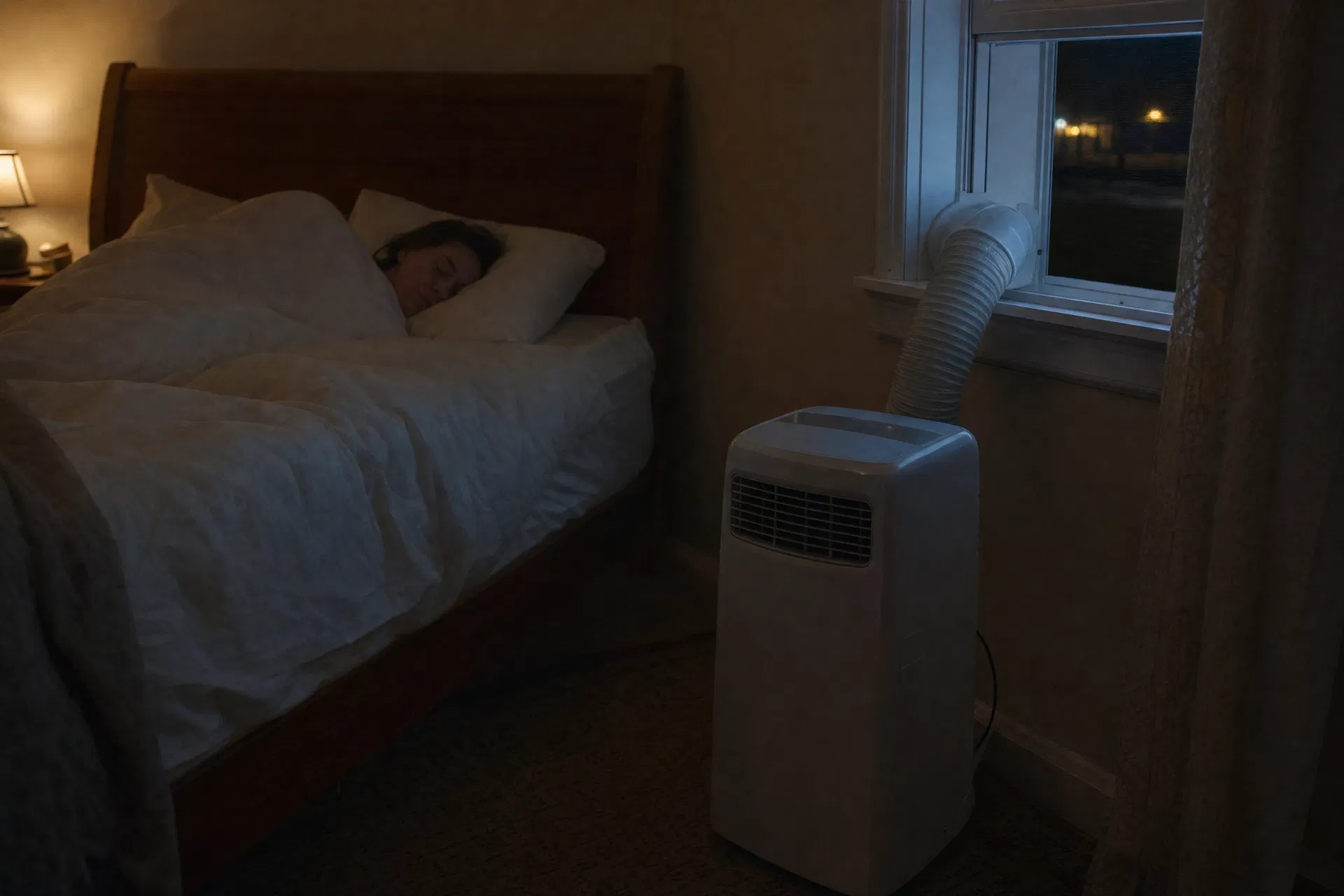
The quietest portable air conditioners for bedrooms in 2026
Most people who shop for a portable AC don't actually want the most cooling — they want enough cooling to sleep, with as little noise as possible. That's a different shortlist, and it's the shortlist most "best portable AC" guides skip past.
Below is the actual quiet-bedroom shortlist, with the dB figures we'd use if we were buying one ourselves, the trade-offs each makes against pure cooling output, and the patterns we'd avoid even if the price looked tempting.
Why portable AC noise is unusually hard to get right
A portable air conditioner is, mechanically, two things: a cooling circuit that compresses and expands a refrigerant, and a fan that moves air across the cold side of that circuit. Both are loud. The compressor produces a low rumble around 100–150 Hz that's especially intrusive at night because human hearing is more sensitive to low frequencies in a quiet bedroom than during a typical noisy day. The fan produces a higher whoosh — much easier to ignore.
Cheap units cut corners on both: undamped compressor mounts that transmit rumble to the casing, and high-pitched fans optimised for airflow rather than acoustic profile. The premium portables we'd actually buy spend money on rubber-isolated compressor mounts, longer fan blades at lower RPM, and acoustic foam in the casing. That money is the difference between a unit you can sleep next to and one that goes back to Currys after a week.
What "quiet" actually means
A few reference points:
- 20 dB: breathing at 1 m, or the noise floor of a quiet rural bedroom.
- 30 dB: library, or a typical sleep-friendly fan.
- 40 dB: quiet office, or a kitchen extractor on its lowest setting.
- 50 dB: light rain, or a refrigerator compressor in the next room.
- 55 dB: suburban background traffic at night.
- 60 dB: normal conversation.
- 65 dB: commercial restaurant kitchen.
A portable AC at 53 dB on its lowest setting is the realistic quiet floor for the category. Anything claimed below 50 dB is almost always measured under conditions a buyer cannot reproduce. The 53 dB figure is what we accept as "fine in a bedroom" — it's noticeable, but most people fall asleep with it running. Above 58 dB we wouldn't put it in a bedroom.
The shortlist
1. De'Longhi Pinguino PAC EL92 Silent — 53 dB minimum
The "Silent" in the name is marketing, but the underlying engineering is real. The EL92 has the rubber-isolated compressor mount and the acoustic foam, and it shows up at 53 dB on its lowest setting in independent measurement. It's not silent. It is, however, the quietest mainstream portable on the UK market, and the Wi-Fi app actually works, which matters for night-time temperature changes you don't want to climb out of bed for.
Cooling output is moderate: a SACC of around 9,000 BTU, suitable for 20–25 m² UK bedrooms. Above 25 m², the compressor cycles long enough to nudge the average noise upward, and the next size up (EL112) is louder again.
2. Midea Duo MPD1-12CRN8 — 54 dB minimum
A close second. The twin-hose design (separate intake and exhaust ducts, fed through the same window kit) is acoustically slightly worse than a single-hose because there's more mechanical complexity, but the cooling efficiency advantage is real — twin-hose portables remove 15–25% more heat per kWh in a closed bedroom, which means the unit cycles less often and the average noise across a night is comparable to the Pinguino's despite the higher peak figure. Slightly utilitarian aesthetics, but the value is unbeatable.
3. Whynter ARC-122DS — 56 dB minimum (US market)
US readers: the Whynter ARC-122DS is a long-running quiet portable that ships with both compressor isolation and a useful drain-pan design that cuts the trickle noise some buyers find annoying. Energy-class equivalent (CEER 9.4) is decent but not best-in-class. We'd rate it the best US-market quiet portable in the 12,000 BTU class for 2026.
4. Daewoo / Comfee SPF1.0H — 55 dB minimum
The budget pick that doesn't ruin sleep. The Comfee is a tier below the Pinguino on every metric — louder, less efficient, plastic-feeling controls — but it gets the basics right and lands at roughly 60% of the Pinguino's price. If your budget is hard-capped at £350, this is the right answer.
5. (UAE / Saudi readers) Sharp CV-P09FR — 55 dB minimum
The Sharp is widely sold across the Gulf market and is the quietest mainstream portable we'd recommend in 28+ °C overnight conditions where the unit will run continuously rather than cycle. The "Plasmacluster" ionisation feature is mostly marketing; the underlying cooling and acoustic engineering is sound.
Patterns we'd actively avoid
- Anything claiming "below 45 dB" at minimum. Physics doesn't allow it for a 9,000+ BTU unit; the spec is either misleading or measured in a way that doesn't translate to a real bedroom.
- "Air coolers" rebadged as ACs at the £150–£250 price point. These are evaporative coolers and don't drop the temperature meaningfully in humid UK summer air. They're also genuinely loud at the higher fan settings needed to make them feel like cooling.
- "Smart" portables with no published dB figures. If the manufacturer is happy to claim Alexa compatibility but unwilling to publish the noise level, infer the worst.
- Unbranded 12,000 BTU units at £200. The combination of cooling output and price implies a corner-cut compressor, which is the part most likely to be loud.
Setup tips that meaningfully reduce noise
These add up:
- Window seal kit (£15). Stops cool air leaking out of the window gap, which lets the unit cycle off sooner — the unit's average noise across a night is what you actually live with.
- Anti-vibration mat under the unit (£12). A 10 mm rubber mat between the AC and a wooden floor knocks 3–4 dB off the rumble that gets transmitted through floorboards. Counter-intuitively, hard tiled floors are quieter than wooden ones for this reason.
- Hose support stand (£20–£25). A flexible exhaust hose drooping at an angle vibrates against the unit's casing. Holding it horizontal eliminates a noise source most buyers don't know they have.
- Set the temperature 2 °C above what you'd choose for "comfortable" in the day. A bedroom at 24 °C with a fan blowing across the bed feels cooler than a bedroom at 22 °C without — and the AC cycles off twice as often.
Frequently asked questions
Will any portable AC let me sleep with the bedroom door closed? Yes. With a window seal kit and the unit on its sleep/eco setting, even a 9,000 BTU portable will hold a 20 m² bedroom at 22 °C overnight without running continuously.
Are inverter portables quieter? Yes, on average. Inverter compressors run at variable speed, so they cycle less aggressively. The Pinguino EL92 and Midea Duo are both inverter units; the cheaper Comfee uses a fixed-speed compressor, which is part of why it cycles more aggressively at the dB peaks.
Where should I position the unit in the room? Near the window (so the exhaust hose is short — long hoses leak heat back into the room) and on the opposite wall to the bed. Air comes off the front of the unit cooler than ambient and recirculates around the room; you don't want that draft pointing directly at you all night.
Can I run the AC off a battery / solar setup? A portable AC pulls 700–1,200 W under load, which is well outside the range of most portable power stations for sustained operation. A 2 kWh battery powers a Pinguino EL92 on eco mode for about 2 hours.
My partner sleeps with no AC and I can't. Any tips? A bedroom-sized portable AC pointed away from the partner's side, plus a small bedside fan on the AC-tolerant side, is the standard solution. The fan creates evaporative cooling on your skin without lowering room temperature; the partner gets ambient conditions they're happy with.
Bottom line
For most UK / EU bedroom buyers in 2026, the De'Longhi Pinguino PAC EL92 Silent is the right answer at the £450–£550 price point. The Midea Duo MPD1-12CRN8 is the right answer at £350–£420. Anything cheaper than that involves trade-offs significant enough to break sleep.
For US buyers, the Whynter ARC-122DS is our pick. For Gulf-region buyers, the Sharp CV-P09FR.
Use the buy buttons on each linked product page for the current live retailer price; the figures in this guide are checked daily but may be a day or two old.
Use the advice tool to get a ranked recommendation tailored to your room, budget, and country.
Open the advice tool